Chromatography fraction pooling that ends by driving a robot
An algorithm proposes, an operator admits — eight chromatograms with pool suggestions, each pending Approve, Reject or Combine.
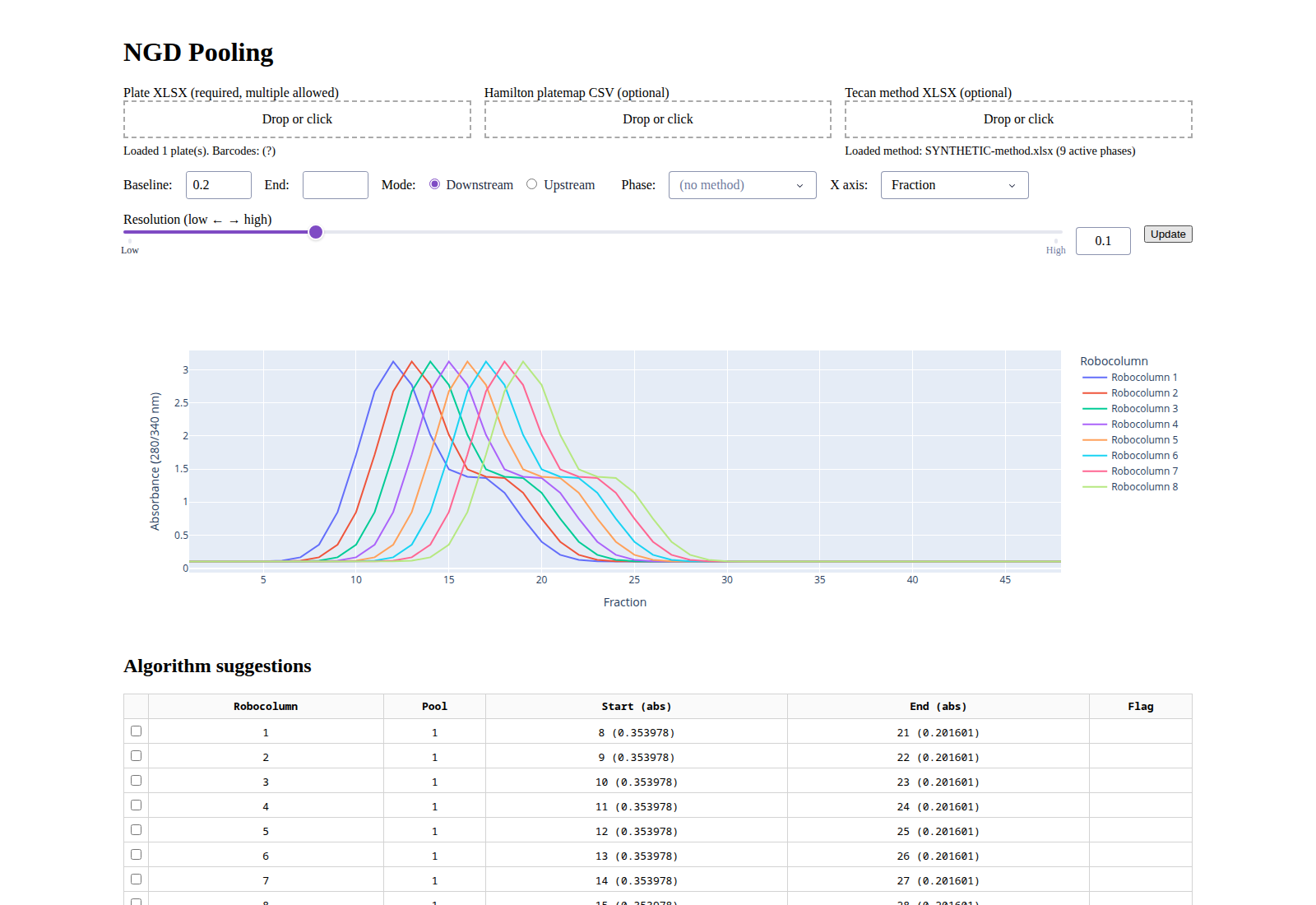
Reads plate-reader output, generates per-column chromatograms, proposes pools with a second-derivative detection algorithm, and lets an operator approve, reject, combine or edit before exporting a bundle that drives the next robotic run.
Generic peak detection found bands opportunistically, and when a diagnostic band was missed the ratio depending on it came back absent — reported as missing data rather than as a detection failure. The rebuild bridges noisy interior dips so one peak does not split into two, derives cut points from shoulder valleys and inflections, and harmonizes bands across samples so ratios are computed over canonical windows rather than per-sample ones. A previously failing sample went from R² 0.26 to 0.98; an implausible aggregation-index range of 1.3–2.7 fell to 0.09–0.53.
Said plainly in the report: harmonization fixes consistency, not detection. Where the fit still misses a band the ratio is genuinely absent — not estimated, not quietly interpolated.
This tool was agentic before the word: an algorithm proposes, a human admits, a robot acts. Any autonomous version does not add a gate, it replaces one that was already load-bearing — a far higher bar than automating something ungoverned. And because the output actuates, a gate beside the execution path is worthless.
No public URL — internal system.