Certified reuse of quantum results, with refusal as a visible outcome
A variational quantum algorithm resubmits nearly the same circuit over and over. Whether the previous answer may be reused is a decision someone has to be able to audit.
Two demos, seeded and offline. One puts a nine-qubit assembly problem and a trained classifier behind a gate that logs every admission; the other drops quantum entirely for a fed-batch reactor model, to show what a regulated step is already expected to leave behind. Small enough to verify by brute force, and verified.
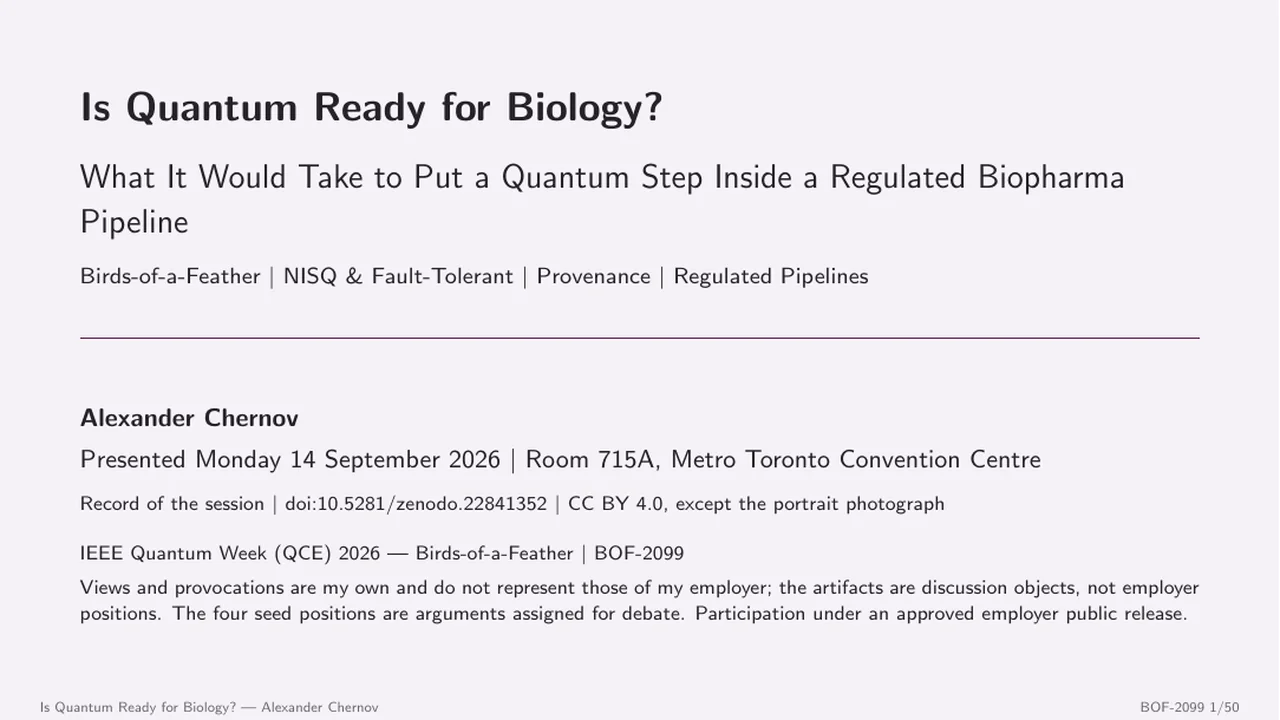
Two runnable demonstrations of what it takes to put a computational step inside a governed biology workflow. The first runs a published quantum genomics method and a trained quantum classifier on PennyLane behind a control plane that decides what may run and records what happened — admission control, rate limiting, a circuit cache and an event record, over QAOA de novo assembly with three reads and nine qubits, verified against brute force.
The second is deliberately not quantum: a mechanistic fed-batch CHO bioreactor under a contract of in-process limits, with a search controller that picks a feed plan from 256 candidates and writes the decision artifact. It is the yardstick — the kind of decision record a regulated bioprocess step already has to leave behind.
Neither demo claims quantum advantage. Every instance is small enough to check classically, and each one is checked. The demos are seeded and run offline, so the reported numbers repeat.
The companion control plane is offered to be attacked rather than admired: it runs entirely in the browser with no backend, so every verdict it reaches can be reproduced by the reader.
References
- Cerezo et al. (2021). Variational quantum algorithms. Nature Reviews Physics 3(9), 625–644. doi:10.1038/s42254-021-00348-9
- Preskill (2018). Quantum Computing in the NISQ era and beyond. Quantum 2, 79. doi:10.22331/q-2018-08-06-79
- Bergholm et al. (2018). PennyLane: Automatic differentiation of hybrid quantum-classical computations. arXiv preprint. arXiv:1811.04968
qubit.agenticdatasets.orgBOF-2099 session pageok-quantum-biology-demosZenodo 10.5281/zenodo.22741061Slides: Zenodo 10.5281/zenodo.22841352