Batch records as typed programs
Approval is a node, not a convention — typed ports, only same-typed ones connect, and human approval sits inside the grammar.
A designer for master batch records (MBR) that executes them as electronic batch records (EBR), in Rust and React, with a no-backend browser build for places that will not host a server. One spine underlies every recipe — source, pre-process, reason, approve, sink — and the records live in version control, so review, promotion and rollback are the ordinary git ones.
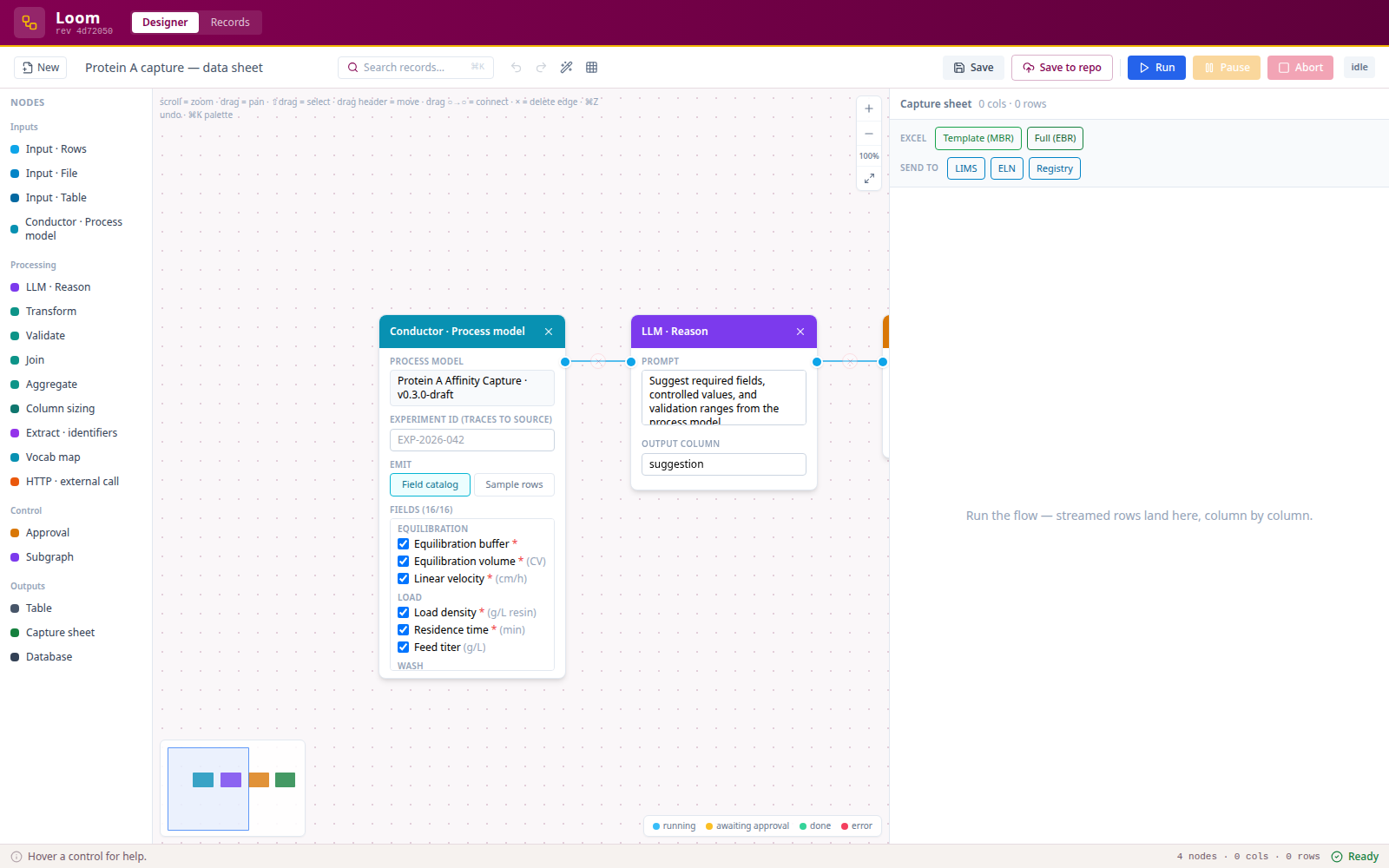
Batch records are authored as documents and executed as programs, and the gap between the two is where validation effort goes. This is a visual builder in Rust and React where the MBR is authored as a graph and every run of it yields the EBR, including a browser-only build with no backend at all, so the authoring surface works where a server cannot be deployed.
The grammar is a visual pipeline with a type system: boxes are nodes, arrows are typed edges — rows, table, scalar, signal — and only same-typed ports may be wired. Every recipe instantiates one spine: source, pre-process, reason (AI), approve (human), sink. Human approval is a first-class node in the grammar rather than a workflow convention bolted on afterwards — the same conclusion as the pooling gate above, reached independently in a different domain. Records are governed in git: review, environment promotion, rollback.
Underneath it, twenty years back to pharmaceutical manufacturing execution systems in validated GxP environments.
References
- IEC (1997). IEC 61512-1: Batch control — Part 1: Models and terminology (ISA-88). International standard. webstore.iec.ch
- U.S. FDA. 21 CFR Part 11: Electronic records; electronic signatures. Code of Federal Regulations. ecfr.gov
- Kelley (2009). Industrialization of mAb production technology: The bioprocessing industry at a crossroads. mAbs 1(5), 443–452. doi:10.4161/mabs.1.5.9448
No public URL — internal system.